

Permission to Act for People and Planet denied: Planning Update for Climate and Community
I am a Trustee of Climate and Community, an environmental Charity in Swansea, I read with interest a recent report from the UK Climate Adaptation Committee Report to Parliament 2025. The Chair Baroness Brown is very concerned that Climate Change adaptation is not being taken seriously across government and consequently not prioritised. This certainly reflects our experience on the ground. Most of us know Climate Change is happening and that government at all levels should allow reasonable projects on the ground to happen to fix the climate risks and consequences we are all facing in the public interest.
‘ Never doubt that a small group of thoughtful, committed, citizens can change the world. Indeed, it is the only thing that ever has.’’ Margaret Mead
But as you may have noticed; this permission for ordinary people to act on the ground by government isn’t happening so readily or with the seriousness or scale required to mitigate the famine that government and mainstream science tells us is coming. The closer science looks at these consequences the more serious they are and arriving more quickly. Ten years ago potential famine conditions in England and Wales were forecast by the end of the century, now it is predicted before mid-2060’s Impacts of Climate Change on Global agriculture Accounting for Adaptation. The government policy and action seems focussed on electricity supply and concerns about current economic growth. We do not eat electricity. Our Charity has been focussed on local sustainable food supply and emissions cuts. Surviving in the current economy while trying to change its values at the same time is not easy.
After being involved in many practical climate change adaptation land based environmental projects for over 25 years, in 2017 we set up Climate and Community as a registered Charity to implement a community environmental educational learning programme which focusses on the consequences of climate change and what we can practically do about it.
As founders of the Charity our experience and qualifications are wide. Bob Smith was a soldier and later a software engineer designing safety systems for UK nuclear power station control rooms, leaving the industry in early 90’s to re-skill in land based skills such as coppicing, hedge laying, greenwood working, carpentry, engineering and mechanics. Jules Wagstaff has a degree in Environmental science, a PGCE and reskilled in land based skills and teaches basketry.
The Charity first focussed on land based rural skills and climate education; after learning carbon negative food growing methods in the Gower using wood chip in 2017 and studying the Climate Change Assessment Report 2, Evidence Report detailing the progression and predictions on rainfall patterns in the UK and the projected loss of half to three quarters of the best arable land in the south east and east coast by the 2050’s (high emission scenario Cranfield study DEFRA and Exeter University 2019)https://www.researchgate.net/publication/336163244_Large_changes_in_Great_Britain’s_vegetation_and_agricultural_land-use_predicted_under_unmitigated_climate_change. We focussed on food growing and local food security. It seemed like a no brainer. These forecasts are little known by the wider public and even less is known by them on what to do about it.
As the Dalai Lama states: ‘Universal responsibility is the real key to survival (human adaptation); large human movements spring from individual initiatives. Therefore it is the individual working from the common welfare who makes the difference.’
It is Dharma that this project springs from, an attempt to remove self-interest to solve the problems in our community and have the courage to follow where it leads with resources you can obtain. As a small charity we set out to implement a project informed by the science and Dharma, this got us into a lot of trouble with the current planning system.
 What was the Plan
We proposed a popular public education programme in three parts: A youth empowerment program, a wider messaging to the Swansea people starting a ‘Common Cause’ conversation and thirdly setting up a Climate Conservation Corps focussing on Carbon negative food growing on the peri-urban areas of Swansea. A location near to the city to attract volunteers to learn skills and be part of a practical climate change project. The rationale for this is the need for a visible climate focussed project in the area; which raises a profile in tandem with the public education. Where the climate connection and purpose is clearly explained via the demonstration plot where an opportunity to volunteer, re-skill and learn about climate change is accessible and at low or no cost. It was contained in a report we sent to all Councillors in 2020 after Swansea declared a Climate Emergency.
In 2020 the Charity was offered a 6 acre site to lease from a private landowner in the Gower after hedge laying on the village recreation green with local volunteers.
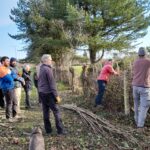
The charity began in 2020 to establish a temporary portable skills camp in the field in agreement with the landowner. COVID delayed our plan but we survived a challenging time. We began working on the infrastructure of the field and woodland to accommodate setting up a no dig carbon negative food growing project as an educational demonstration plot open to the public. The site had no secure structures for tool storage, no water supply, an unsurfaced sloping 170m track to the road and numerous ash dieback trees requiring felling. It was hard work.
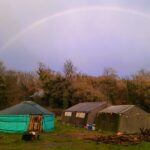
These practical issues took more time to solve as volunteers used appropriate technology and low fossil fuel methods. Portable structures such as military tents, yurts and 2 containers were used for tool storage and site workshop facilities. Creating a camp inspired by the Civilian Conservation Corps of 1930’s America set up by Roosevelt in the Great Depression. The New Deals most popular initiative which created camps in every state for 3 million men to implement emergency conservation projects including planting 2 billion trees. Roosevelt’s famous speech in 1933 summarised his inspiring plan ‘I propose to create a Civilian Conservation Corps to be used in simple work, not interfering with normal employment; confining itself to forestry, the prevention of soil erosion, flood control and similar projects. More important however than the material gains will be the moral and spiritual values of such work…it is not a panacea for all unemployed but it is an essential step in this emergency.’
Alas, as yet no such initiative for this emergency has been delivered or supported by Welsh Government. So we set up a low budget DIY version. We believed the temporary structures could be accommodated by planning law; but we knew we would have to eventually make that case.
On November 15th 2022 two planning enforcement officers visited our field and the real battle of permission began. How does the public interest, harm and loss of public amenity actually get assessed for any development said to be in breach of planning law? Considering that the majority of planning law was made more than 3 decades ago; it cannot reflect the most severe current climate risks and their urgency to act.
By March 2023 the Charity was issued with a Planning Contravention Notice, followed by a face to face meeting with two planning officers and 8 Charity volunteers. Any route to mediation was refused and only the complete removal of all structures was offered as a remedy. Hardly a remedy more a tyranny. An Enforcement report was written in November 2024 contents unknown to the Charity and presented to a planning committee in private. By March 2024 an Enforcement notice was issued and the real work was to appeal the enforcement and discover the contents of the LPA case by securing a copy of the Enforcement Action Report (EAR) through a Freedom of Information Act. The EAR was the origin of the problem; a document which omitted any detail about the Charity and its charitable activity; sowed doubt at every opportunity that we were a bonafide charity and questioned the legitimacy of the Charity’s lease or its learning programme. There was no description of the project information we had supplied to the planning officers. But we were described as ‘Inappropriate, Unacceptable and unlawful’
The Charity appealed but was refused a hearing by PEDW counter to their own rules which recommend a hearing if it is requested . The Human Rights Act Article 6 requires that citizens have a right to a hearing. A written determination via a tortuous timetable of paper work ensued. The Inspectorate again denied us a hearing but upheld the enforcement on December 4th 2024. Within 2 years the planning system had decided the climate adaptation project was harmful to the amenity and not in the public interest. Permission by the Government denied.
 But What is the Public Interest anyway?
The planning system is not transparent or accessible, it requires legal agents with a high price tag to navigate its quasi-judicial process. As trustees we did a lot of background research to represent the Charity ourselves.
The Royal Town Planning Institute Report: Serving the Public Interest 2019https://www.rtpi.org.uk/new-from-the-rtpi/serving-the-public-interest-uk-planning-services-in-an-age-of-outsourcing/ has helpful insights into the challenges of defining and applying public interest in planning. We find there is no one definition. Climate change risks and adaptation measures are considered; but the overriding political drive for economic growth and jobs dictates the decision making. In Wales the Future Generations Act 2015 and Sustainable Development policy try to define further the public interest; however these are not legally enforceable and can be another tick box exercise if the will to apply them is absent and in practice the Local Development Plans over ride them.
Local Development Plans include some inclusion of Climate Policy. In Swansea LDP this was ER1 which was in brief ‘’To mitigate against the effects of climate change, adapt to its impacts ensure resilient development principles taking into account…. .’’ It appears that ER1 requires by the planner to understand the holistic and strategic nature of a proposed or existing development.
The tool of the planner to do this is the idea of ‘’balance’’ which represents the central structural component of the UK planning system applied by professional expertise and discretion. In recent times a number of changes in the planning environment has bred up; as RTPI call the ‘austerity planner’ who works in more of a ‘private sector’ working practice and adopts and embraces the increasing box ticking, target driven proceduralism which undermines and shuts down reflective decisions made in the public interest. Threatening the headspace planners have to think pro-actively and strategically. Also undermining professional discretion and judgement; to make decisions on material considerations beyond policy. In some instances creating a perceived fear of reputational threat if decisions are made outside of strict policy adherence. Political leadership is a strong driver in this. In practice a ‘soft denialism’ emerges in the planning approach. Hyper cynicism for emerging climate adaptation or what some call Transformative Adaptation.
Simply because outright climate change denial is unacceptable in government yet the solutions can be manipulated and massaged into meaningless messages and targets.
These influences are crucial to the decisions made with regards to changing climate projections and emerging adaptation projects. If a planner took climate science seriously, they may be making decisions outside of current policy and be accused of maverick behaviour. They wouldn’t last long.
 Assessing the alleged ‘harm’
The planners assessing the Charity’s project did not ‘get’ what we were trying to do in the context of climate adaptation. And exercised great prejudice and pre-determination to fit a preconceived narrative which redefined our ‘development’.
An Enforcement Notice described the breach as a material change of use of the land to a mixed use comprising residential and educational use (and associated erection of 2 yurts and tents and 2 storage containers). The Charity appealed this Enforcement by asking for planning permission for the breach, with the aim to regularise the situation. We conducted the case with help from Planning Aid Wales. Our Advisor believed the creation of 3 off site carparking places and some other conditions on site use would be sufficient for us to continue our valuable work. We asked for temporary planning for structures which were to be dismantled after the expiry of the lease in 2030. In effect asking for 5 years temporary planning permission for portable structures for students and instructors. The structures represented 99% cuts in embodied emissions of accommodation and approximately 95% of ongoing emissions.
The main issues considered by Welsh Government Inspectorate were: Compatibility with regard to the Development Plan; effect on highway safety, effect on character and appearance and effect on the living conditions of local occupants in the area.
The charity also put forward an argument that the LDP climate change policies and the presumption for sustainable development support our planning case and outweigh any amenity loss or other harm and in fact balances the concerns of LPA with respect to place making and place management and development in the countryside.
Planning was refused on the basis that the project as an agricultural, forestry or rural enterprise did not pass financial tests for a rural business and the scale and reach of any benefits of the development to climate, biodiversity and wellbeing aims is likely to be limited. The harm to the countryside, policy integrity and highway safety set out is moderate. Therefore it was decided by the Welsh Ministers Inspectorate that the benefits of the development did not out-weigh the harm.
Our opinion is that the Swansea LPA and Inspectorate misrepresented our project, and exaggerated potential harm; adhered to the LDP by defining us as a business which did not pass financial tests for rural enterprise and focussed on on-site education rather than all the education, we do to build a volunteer base and profile offsite in the community. Ignores that we had run our activities with no complaints or impact to the highway and had a workable route for volunteers to use via bus and bicycle for 4 years. The visual impact was complained about by 5 people, our closest neighbours. Ignored the 39 positive submissions because they were referring to training off site or Welsh organisations like Climate Cymru, and the Swansea Environment Centre which supports our work or local academics who approve and support our aims and methods.
 So how can we defend the wider public interest?
We have learned first-hand from our initiative the barriers which hinder, slow down and stop adaptation. In practice the planners do not recognise what they see on the ground. Adaptation and mitigation projects are not all going to be shiny high tech. More likely small groups of people with forks and spades talking about wide scale coppice creation to facilitate fungal association growing beds. Not business suits and power point presentations.
In planning law the Charity had 28 days from the decision date to appeal to the High Court on procedural grounds. We used bias and predetermination and denial of a hearing as grounds for appeal. As Trustees it was the hardest bit of paperwork we had ever done. Exhausted we managed to get the application into the Cardiff Administrative Court only to have it sent back to us because we used the wrong forms. Just goes to show that it is the procedural maze in planning which is just as bigger burden as putting forward the legal arguments. It seems to be that you need to be very rich or have nothing to lose to pursue a High Court Judicial Review. This will not drive the change needed to the planning system in the time needed to increase the acreage of growing land and make easier routes to essential development in the countryside required for the growers and the infrastructure to service the required sustainable production of food a service thousands more food growers.
Please write to Rebecca Evans MS Cabinet Secretary for Energy Economy and Planning
Email: Rebecca.Evans@senedd.wales
The more letters and interest on these issues the better in making the planning system more radically accountable for the oncoming food crisis and the need for local food supply as a climate adaptation strategy to be reflected in the assessment of the public interest and harm.
Miss Jules Wagstaff BSc PGCE Trustee
Climate and Community (Registration Number 1172500)
Mob 07964530436
climateandcommunity@btinternet.com
C/O The Environment Centre
Pier Street, Swansea
SA1 1RY.
